Home/Collections/The Paint Box: Source of Inspiration and Artwork
The Paint Box: Source of Inspiration and Artwork
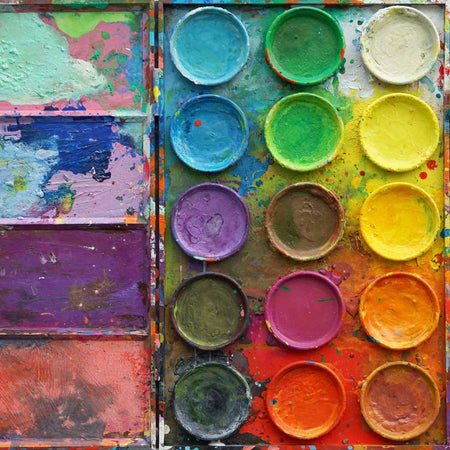
Almost every artist knows the moment when there is more paint in the paintbox than on the picture. Normally it goes unnoticed. In this series, it becomes the starting point of the art. The paintbox leaves its role as a tool and becomes a work of art in its own right – somewhere between painting, object and space.
Abstract painting between image, object and space
The paint box is normally a tool. In this series it becomes an artwork in its own right. What usually serves as preparation in the studio moves to the centre of attention and is reimagined as a contemporary wall object.
These works move between abstract painting, object, and spatial presence. The result is artworks with vivid colors that do not depict color, but visibly store it. Anyone wishing to discover contemporary art online or buy abstract painting will find here an independent, unusual body of work.
How the Farbkasten works are created
The starting point of this series lies in an everyday observation: in the used palettes of my painting students, images were already laid out. Dried paint residues, overlays, and accidental mixtures told of decisions, movements, and time.
These traces were enlarged and further developed. On oversized replicas of a paint box, large-format artworks are created in which colour is organised spatially. The works are genuinely three-dimensional and deliberately move between painting and contemporary wall sculpture.
Large-format wall objects and light
This art needs space! The contemporary wall objects respond sensitively to light, shadow and distance. Depending on the time of day, colours, contrasts and spatial depth change.
In generous living or working spaces they unfold their full presence. Anyone wishing to buy a large format or specifically looking for contemporary wall decoration as sculpture should give these works space – they are conceived as an active part of the architecture.
Between Memory and Abstraction
The visible remnants of paint refer simultaneously to past paintings and future possibilities. Titles, color harmonies, and structures open up spaces of association – personal, abstract, and sometimes surprisingly concrete.
Without a fixed plan, spontaneous form and color compositions emerge. In this way, a special connection develops between painting, object, and meaning – between the concreteness of the tool and the openness of abstract art.
Visits, acquisitions, and digital presence
Anyone who would like to experience the works from the Der Farbkasten series in person is warmly invited to arrange an appointment at the studio.
Atelier HellbuschLangendellschlag 6265199 Wiesbaden📧 markhellbusch@web.de📞 0176 – 219 16 227
FAQ
How did the “Der Farbkasten” series come about?
The starting point was the traditional paintbox as a painter’s tool. I was interested in the question of whether countless painting ideas might already be hidden within it. In this series, the paintbox itself becomes a work of art and a carrier of colour, memory and artistic process.
Are the works paintings or wall objects?
The works deliberately move between both areas. They possess the colourfulness and visual language of a painting, yet through their spatial structure they simultaneously develop the presence of a wall object. With a depth of around 3 to 8 centimetres, they project clearly into the room and change their effect depending on the light. This gives the works a sculptural quality that goes beyond classical painting.
Can several paintboxes be displayed next to each other?
In principle yes, although I would generally advise against it. The paintbox is conceived as an independent wall object and needs space to unfold its effect. When several works are presented directly next to each other, a certain restlessness often arises, as the pieces compete for attention. In most cases, a single paintbox has a stronger impact than several works hung closely together.
Which materials are used?
Depending on the work, canvas, wood, acrylic paint, concrete, water-mixable oil paint, adhesives, and leftover paint from the studio are used. Many materials are directly related to the painting process itself. The top layer of paint usually consists of water-mixable oil paint.
Are all works one-of-a-kind pieces?
Yes. Each work is created as a one-off piece in the studio. Structure, colours and material traces develop individually and cannot be reproduced.
When does a paintbox work?
The paintbox emerges from an experimental process. Experimental, however, does not mean arbitrary. Throughout the work, it is repeatedly checked whether the piece engages both the eye and the mind.
Does the eye keep moving across the surface in new ways? Do you still discover further connections after weeks or months? Do different associations arise over time? When a work preserves this openness and does not lose its impact, it begins to function.
Why should I buy a paintbox?
A paintbox is more than a painting. These works combine painting, object art and the visible creation process of an image. They change their effect with light, distance and viewing time, continually opening up new associations.
Anyone who acquires a paintbox is not just buying a picture, but an independent art object that can be discovered anew over many years.
In Conclusion
These works are aimed at people who do not see contemporary art as decoration, but as a conversational partner in the room.
Almost every artist knows the moment when there is more paint in the paintbox than on the picture. Normally it goes unnoticed. In this series, it becomes the starting point of the art. The paintbox leaves its role as a tool and becomes a work of art in its own right – somewhere between painting, object and space.
Abstract painting between image, object and space
The paint box is normally a tool. In this series it becomes an artwork in its own right. What usually serves as preparation in the studio moves to the centre of attention and is reimagined as a contemporary wall object.
These works move between abstract painting, object, and spatial presence. The result is artworks with vivid colors that do not depict color, but visibly store it. Anyone wishing to discover contemporary art online or buy abstract painting will find here an independent, unusual body of work.
How the Farbkasten works are created
The starting point of this series lies in an everyday observation: in the used palettes of my painting students, images were already laid out. Dried paint residues, overlays, and accidental mixtures told of decisions, movements, and time.
These traces were enlarged and further developed. On oversized replicas of a paint box, large-format artworks are created in which colour is organised spatially. The works are genuinely three-dimensional and deliberately move between painting and contemporary wall sculpture.
Large-format wall objects and light
This art needs space! The contemporary wall objects respond sensitively to light, shadow and distance. Depending on the time of day, colours, contrasts and spatial depth change.
In generous living or working spaces they unfold their full presence. Anyone wishing to buy a large format or specifically looking for contemporary wall decoration as sculpture should give these works space – they are conceived as an active part of the architecture.
Between Memory and Abstraction
The visible remnants of paint refer simultaneously to past paintings and future possibilities. Titles, color harmonies, and structures open up spaces of association – personal, abstract, and sometimes surprisingly concrete.
Without a fixed plan, spontaneous form and color compositions emerge. In this way, a special connection develops between painting, object, and meaning – between the concreteness of the tool and the openness of abstract art.
Visits, acquisitions, and digital presence
Anyone who would like to experience the works from the Der Farbkasten series in person is warmly invited to arrange an appointment at the studio.
The starting point was the traditional paintbox as a painter’s tool. I was interested in the question of whether countless painting ideas might already be hidden within it. In this series, the paintbox itself becomes a work of art and a carrier of colour, memory and artistic process.
Are the works paintings or wall objects?
The works deliberately move between both areas. They possess the colourfulness and visual language of a painting, yet through their spatial structure they simultaneously develop the presence of a wall object. With a depth of around 3 to 8 centimetres, they project clearly into the room and change their effect depending on the light. This gives the works a sculptural quality that goes beyond classical painting.
Can several paintboxes be displayed next to each other?
In principle yes, although I would generally advise against it. The paintbox is conceived as an independent wall object and needs space to unfold its effect. When several works are presented directly next to each other, a certain restlessness often arises, as the pieces compete for attention. In most cases, a single paintbox has a stronger impact than several works hung closely together.
Which materials are used?
Depending on the work, canvas, wood, acrylic paint, concrete, water-mixable oil paint, adhesives, and leftover paint from the studio are used. Many materials are directly related to the painting process itself. The top layer of paint usually consists of water-mixable oil paint.
Are all works one-of-a-kind pieces?
Yes. Each work is created as a one-off piece in the studio. Structure, colours and material traces develop individually and cannot be reproduced.
When does a paintbox work?
The paintbox emerges from an experimental process. Experimental, however, does not mean arbitrary. Throughout the work, it is repeatedly checked whether the piece engages both the eye and the mind.
Does the eye keep moving across the surface in new ways? Do you still discover further connections after weeks or months? Do different associations arise over time? When a work preserves this openness and does not lose its impact, it begins to function.
Why should I buy a paintbox?
A paintbox is more than a painting. These works combine painting, object art and the visible creation process of an image. They change their effect with light, distance and viewing time, continually opening up new associations.
Anyone who acquires a paintbox is not just buying a picture, but an independent art object that can be discovered anew over many years.
In Conclusion
These works are aimed at people who do not see contemporary art as decoration, but as a conversational partner in the room.